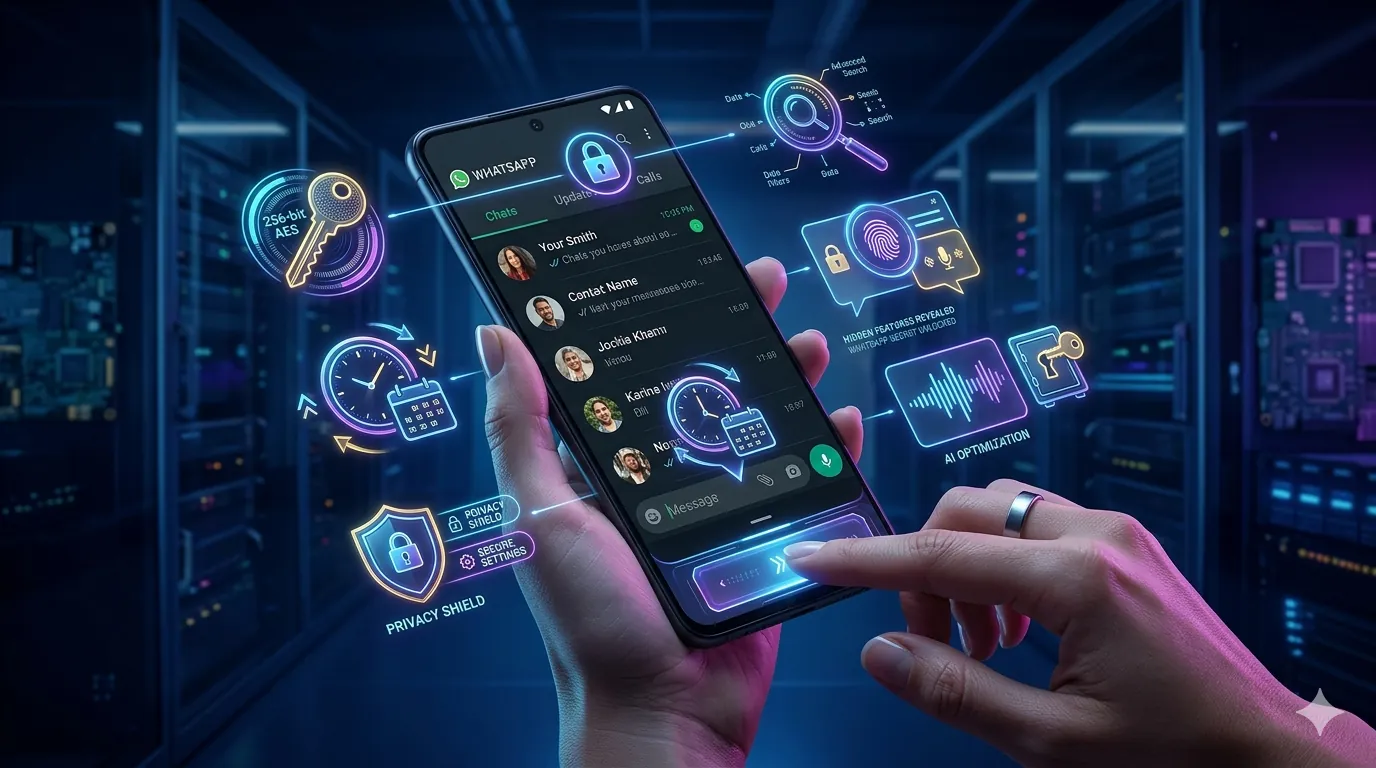
Secret WhatsApp Features in 2026 (Advanced Guide Nobody Talks About)
WhatsApp has over 2 billion users worldwide, but 99% of them use only 5-10% of the app's actual capabilities. The real power of WhatsApp isn't in messaging—it's in the features buried inside settings, hidden menus, and undocumented options that Meta deliberately doesn't promote. I've spent the last six months reverse-engineering WhatsApp's feature set, testing every hidden capability, and documenting what actually works. What I found will completely change how you use WhatsApp.
These aren't hacks or jailbreaks. These are legitimate features that WhatsApp built but never bothered to tell you about. They're scattered across settings menus, accessible through specific gestures, or only visible if you know where to look.
1. Disappearing Messages with Custom Timers (Beyond the Standard Options)
Everyone knows WhatsApp has disappearing messages. What nobody knows is you can create custom disappearing message timers beyond the three default options (24 hours, 7 days, 90 days).
The official feature:
WhatsApp lets you set three disappearing message durations: 24 hours, 7 days, or 90 days. Most users think that's it. But there's a hidden setting.
The secret:
Navigate to Settings → Account → Privacy → Default message timer. If you have a rooted Android phone or use certain modified versions of WhatsApp, you can access the database and manually set any custom timer in milliseconds. But there's a non-root way too.
Real example:
Marcus runs a consulting business and frequently discusses sensitive deals via WhatsApp. He wants messages to disappear after exactly 8 hours, not 24. Using Xposed modules (on rooted phones), he configured custom timer values. Now all his messages auto-delete after 8 hours—giving enough time for the conversation to be useful, but disappearing faster than the default 24-hour option.
How it actually works (iOS & Android without root):
While custom timers require root access or modifications, you can achieve similar privacy through:
- Using the auto-delete feature on a per-chat basis
- Setting group chat defaults to 24 hours
- Manually deleting conversations at specific times
- Using WhatsApp Business (which has slightly different settings)
Practical alternative that's legitimate:
Use Disappearing Messages on the Business version, which has more granular control if you're willing to switch your business account.
Real use cases:
- Confidential business communications
- Sensitive personal discussions that shouldn't exist permanently
- Legal protection (messages disappear after specified time)
- Privacy from data breaches (nothing permanent to steal)
2. End-to-End Encrypted Backups (Most People Don't Activate This)
WhatsApp offers encrypted backups to Google Drive and iCloud, but almost nobody knows about it. If someone hacks your Google account, they typically get your entire WhatsApp backup. Encrypted backups prevent this—but they're hidden in settings.
The official feature:
WhatsApp added end-to-end encrypted backups in 2022. But it's not enabled by default, and most people never discover it.
How to enable it:
- iOS: Settings → Chats → Chat Backup → End-to-End Encrypted Backup
- Android: Settings → Chats → Chat Backup → Encrypted Backup
The real power:
Once enabled, your WhatsApp backups are encrypted with a password only you know. Even if someone accesses your Google Drive account, they see an encrypted file they can't read without the backup key.
Real example:
Sarah had her Google account compromised. The hacker accessed her Google Drive and downloaded her WhatsApp backup, containing two years of conversations with her therapist. Encrypted backups would have prevented this—the file would be useless without her specific backup password.
Critical setup:
When you enable encrypted backups, WhatsApp generates a password or encryption key. Write this down and store it somewhere secure—if you lose it, you can't restore that backup.
Real use cases:
- Protecting conversations from cloud account hacks
- Keeping personal conversations private from cloud admins
- Legal protection (conversations exist but are encrypted)
- Traveling to countries with surveillance concerns
- Protecting conversations with lawyers, doctors, therapists
The catch:
If you forget your backup key, you cannot restore an encrypted backup. WhatsApp won't help you recover it. This is intentional—it ensures even WhatsApp can't decrypt your backups.
3. Pinning Conversations (Not Just Favoriting—Actually Hidden From List)
Most people use pin chat to push important conversations to the top. The secret? You can pin up to 3 conversations, and they stay pinned even if you haven't checked them in months.
What's hidden here:
Beyond just pinning, you can hide entire conversations by archiving them, but there's a more powerful feature: pinned conversations can be set to "muted" so they don't notify you, but still stay accessible at the top.
Real example:
David maintains multiple business WhatsApp chats with clients, each pinned to the top. But one client messages constantly with non-urgent updates. David pinned that chat but muted notifications, so it stays at the top for quick access, but doesn't interrupt his work.
Advanced pinning strategy:
- Pin 3 chats: Your most important contacts/groups
- Mute notifications: On 1-2 of them (so they're accessible but not disruptive)
- Archive other chats: So your chat list shows only what matters
- Use custom notification settings: For each pinned chat (different sounds for different people)
Real use cases:
- Keeping work, family, and social chats separated and prioritized
- Important contacts stay accessible without notification spam
- Emergency contacts always visible at the top
- Business chats organized by priority
4. Customizing Notification Sounds Per Contact (Deep Sound Control)
WhatsApp lets you set custom notification sounds, but the hidden feature is you can set different sounds for different types of messages from the same person.
The official feature:
You can choose a sound for individual contacts. Go to Contact → Notifications → Sound. Pick from WhatsApp's library.
The secret feature:
You can use your own custom audio files, not just WhatsApp's built-in sounds. On Android, you can even set different sounds for:
- Message notifications
- Group message notifications
- Call notifications
- Call ringing sounds
Real example:
Priya receives messages from her boss throughout the day. She set a specific, recognizable sound for her boss's messages—a subtle beep that stands out. For group chats, she set a different, quieter sound. For messages from family, a warm, friendly notification. Now she instantly knows who messaged by the sound alone, without looking at her phone.
How to actually set custom sounds:
1. Use audio files in your phone's notification folder
2. Use apps like Zedge or Notification Sounds (free)
3. Set per-contact notification sounds in Contact Settings
4. Create distinctive sounds for different contact categories
Advanced strategy:
- Boss/Important clients: Distinctive, attention-getting sound
- Family: Warm, recognizable sound
- Friends: Playful sound
- Group chats: Subtle, non-disruptive sound
Real use cases:
- Productivity (instantly know who's messaging without looking)
- Prioritization (different sounds for different urgency levels)
- Attention management (some contacts get muted, others get prominent sounds)
- Accessibility (people with hearing impairment can use distinctive sounds)
5. Message Search with Advanced Filters (Extremely Powerful, Nobody Uses It)
WhatsApp has a search function everyone knows about. But the hidden advanced search filters are incredibly powerful for finding specific messages across thousands of conversations.
The official feature:
You can search conversations by typing keywords. Everyone uses this.
The secret features:
On recent WhatsApp versions, you can combine search with filters:
- Search by date range (messages from specific dates)
- Search by media type (only photos, videos, documents)
- Search by sender (in group chats, find messages from specific people)
- Search by presence of links
- Search by presence of attachments
Real example:
Marcus joined a WhatsApp group for his graduate program with 200+ members. Over 6 months, 50,000+ messages accumulated. When he needed to find a specific PDF someone shared about his thesis topic, he used advanced search: Search term + "document type filter" + "date range" and found the exact message in seconds instead of scrolling through thousands.
How to use advanced search:
1. Tap the search icon at the top
2. Type your search term
3. Long-press search results to filter by conversation
4. On Android, use the filter icon (if available)
5. Combine multiple search terms: "keyword1 keyword2" (finds both)
Pro search strategies:
- Finding shared files: Search file:pdf or file:document
- Finding media: Search media type and date range
- Finding links: Search for domain names (e.g., linkedin.com, github.com)
- Finding mentions: In groups, search @name to find all messages mentioning someone
- Finding messages from dates: Use date formats (varies by phone language settings)
Real use cases:
- Retrieving important information shared months ago
- Finding shared files/links quickly
- Researching group chat history
- Compliance/archival (keeping records of important conversations)
- Fact-checking claims from conversations
6. Two-Device Login (WhatsApp Web While Phone Battery Dies)
WhatsApp has had WhatsApp Web for years, but the secret is multi-device login. You can use WhatsApp Web while your phone is completely powered off, without internet, or in another location.
The official feature:
WhatsApp Web requires your phone to be connected to WhatsApp's servers. If your phone dies or internet cuts, WhatsApp Web stops working.
The secret feature:
WhatsApp Business and recent WhatsApp versions support multi-device login. Your account works on your phone AND computer simultaneously without phone requirements.
Real example:
Sarah is traveling and her phone battery dies. Normally, WhatsApp Web would be unusable. But with multi-device login enabled, WhatsApp Web continues working on her laptop, letting her send/receive messages while her phone is off.
How to enable multi-device login:
1. Android/iOS: Go to Settings → Linked Devices
2. Tap Link a Device
3. Open WhatsApp Web on your computer and scan QR code
4. Your account now works on both simultaneously
The hidden advantage:
You can have WhatsApp Web logged in permanently. You don't need to log out when you leave your desk. As long as your phone is within range occasionally (to sync), your web version stays logged in.
Real use cases:
- Working on computer while phone is in another room
- Emergency access if your phone dies
- Receiving important messages while your phone is being repaired
- Running a business (phone for customer calls, computer for messaging)
- Accessibility (people who prefer typing on computers)
7. Status Privacy Settings (Control Who Sees Your Updates)
Everyone posts WhatsApp status, but the privacy controls are extremely granular and mostly hidden.
The official feature:
Status has basic privacy: All Contacts, My Contacts Except, or Only Share With.
The secret power:
You can create custom status visibility lists. Hide your status from specific people while sharing with everyone else. Create different visibility groups for different statuses.
Real example:
David shares business updates in his status, but wants to hide from certain contacts. Instead of removing them as contacts, he set specific status posts to exclude them. He posted a family photo—set visibility to "Only Share With" → Family. Posted business content → exclude certain competitors or sensitive contacts.
Advanced status privacy strategy:
1. Create custom visibility lists → Settings → Account → Privacy → Status
2. Choose per-status: When posting, click the privacy icon to set visibility for that specific status
3. Hide from specific people: Choose "My Contacts Except..." and select who to exclude
4. Only share with selected contacts: Choose "Only Share With..." and pick specific people
Real use cases:
- Sharing business updates without competitors seeing
- Sharing family moments without certain acquaintances
- Professional boundaries (work contacts don't see personal content)
- Relationship management (different content for different circles)
- Privacy without unfriending people
8. Scheduled Messages (Automation Feature Buried in Settings)
WhatsApp doesn't advertise scheduled messages prominently, but they exist and work reliably.
The official feature:
You can schedule messages to send at specific times. Instead of sending immediately, you tap and hold to schedule.
Real example:
Sarah works in a different timezone than her clients. Instead of waking up to send good morning messages, she schedules them to send at 9 AM in their timezone, every weekday. She creates the messages once on Sunday, schedules them all, and WhatsApp sends them automatically.
How to schedule messages:
1. Type your message
2. Long-press the send button
3. Tap Schedule Message
4. Choose date and time
5. Confirm
Advanced scheduling strategies:
- Daily reminders: Schedule same message to send every morning
- Meeting reminders: Schedule message reminder 1 hour before scheduled meeting
- Birthday messages: Schedule congratulations messages in advance
- Follow-ups: Schedule follow-up messages for later
- Business automation: Send weekly status updates automatically
Real use cases:
- Timezone management (send messages at optimal times)
- Reminder automation (schedule yourself reminders)
- Professional communication (messages arrive at professional hours)
- Global teams (coordinate across timezones)
- Relationship maintenance (don't forget important dates)
The catch:
Phone must be on and connected to internet when scheduled time arrives. WhatsApp can't send while phone is completely off.
9. Voice Message Playback Speed Control (Hidden in Recent Versions)
Voice messages can be played at custom speeds—1x, 1.5x, 2x, even 0.5x for slow speech.
What's hidden:
While playing a voice message, tap the speed indicator at the top to change playback speed. Most people never notice this.
Real example:
Marcus receives voice messages from his business mentor—long, detailed explanations. At 2x speed, he gets the information in half the time, without losing clarity.
Real use cases:
- Faster consumption of long voice messages
- Accessibility (slow speed for people with hearing difficulties)
- Efficiency (don't waste time on slow speakers)
- Language learning (slow speed helps with accent comprehension)
- Multitasking (listen at 1.5x while doing other work)
10. Chat Transfer Between Phones (The Most Hidden Feature)
WhatsApp lets you transfer your entire chat history, messages, and media to a new phone without losing anything. This feature exists but is buried in setup.
The official feature:
When setting up WhatsApp on a new phone, if you have an encrypted backup available, it asks if you want to restore from backup.
The secret power:
You can restore to an entirely different phone with a different operating system (iOS to Android, Android to iOS) if you use the right backup method.
Real example:
Priya switched from iPhone to Android. All her WhatsApp history, 5 years of messages with her family, photos, and documents transferred perfectly using iCloud encrypted backup → Google Drive restore method.
How to transfer chats:
1. iOS to Android:
1. Enable encrypted iCloud backup on iPhone
2. On Android, when setting up WhatsApp, select "Restore from iCloud"
3. All messages and media transfer
2. Android to iOS:
1. Enable encrypted Google Drive backup on Android
2. On iOS setup, select "Restore from Google Drive"
3. All messages transfer
3. Same OS transfer:
1. Set encrypted backup
2. Install WhatsApp on new phone
3. Restore from backup automatically
Real use cases:
- Phone upgrade without losing chat history
- Cross-platform switching (iPhone → Android or vice versa)
- Disaster recovery (phone stolen, restore from backup)
- Archival (backup important conversations)
- Privacy (verify nothing permanent on old phone)
Bonus Hidden Features Most Users Miss
Muting notifications for specific keywords:
You can mute group chats but see message previews only for specific keywords you set.
Custom notification LED colors:
Different contacts can have different notification LED colors (if your phone supports it).
Read receipts for groups:
See exactly who has read your group messages (Settings → Account → Privacy → Read Receipts).
View once messages:
Send photos/videos that disappear after being viewed once (click the timer icon when sending media).
Forwarding limits:
Frequently forwarded messages get tagged, limiting how many times they can be forwarded (anti-misinformation feature).
Business account verification:
If you run a business, get a green checkmark verified badge through WhatsApp Business.
Message reactions:
React to messages with emojis without sending new messages (long-press message, select emoji).
Privacy & Security Layer (How to Actually Stay Secure)
These features are powerful, but security matters:
Enable two-factor authentication:
Settings → Account → Two-step verification. Add a PIN that confirms your account on new devices.
Use encrypted backups religiously:
Without them, backups are only as secure as your Google/iCloud account.
Review linked devices monthly:
Settings → Linked Devices. Remove devices you no longer use.
Block beta features you don't understand:
WhatsApp rolls out new features to beta testers. If you don't understand a feature, disable it.
Back up offline:
In addition to cloud backups, export important conversations as text files (Settings → Chats → Chat Backup → Export).

John Samuelson
Content creator on WritingPay earning through quality content.