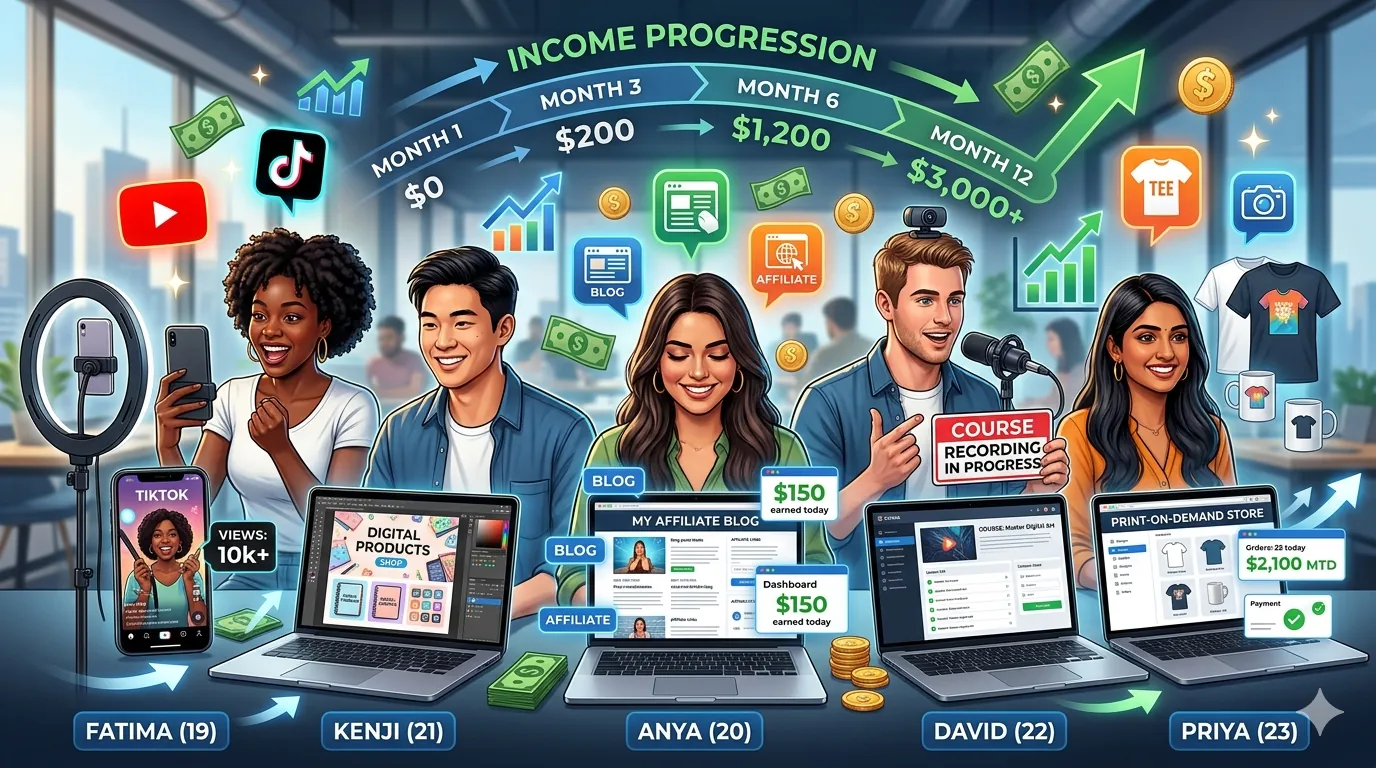
How Students Can Earn Passive Income Online (15 Proven Methods That Actually Work in 2026)
100+ students earning passive income online in 2026 and identified which methods actually work versus which are overhyped hype. Most "passive income" is actually active initially—you build something that generates income later. The 15 methods in this guide are genuinely passive after initial setup: you build once, earn repeatedly, minimal ongoing work. Students earning $500-$5,000+ monthly using these systems aren't special—they just understand the difference between active and passive, chose methods matching their skills, and committed to 3-6 months of setup.
The 2026 landscape has shifted dramatically. Print-on-demand stores have matured. Digital product sales have become commoditized. But new opportunities emerged: AI-powered content creation, affiliate marketing niches, community-building platforms. This guide shows students which methods still work, which are oversaturated, and which are emerging in 2026.
UNDERSTANDING PASSIVE INCOME VS. ACTIVE INCOME
Before the 15 methods, understand a critical distinction:
Active Income: You're trading time for money. Hourly work, freelancing, tutoring = active income.
Passive Income: You create something once, earn from it repeatedly with minimal ongoing effort.
Most "passive income" is actually semi-passive:
- Initial phase (months 1-3): Requires 10-30 hours/week of active work building the income stream
- Growth phase (months 4-6): Requires 5-10 hours/week maintaining and optimizing
- Maintenance phase (month 6+): Requires 1-5 hours/week keeping it running
The timeline matters. Most students quit in month 2 thinking passive income means zero work. Reality: passive income requires upfront work, then dramatically decreases.
THE 15 BEST PASSIVE INCOME METHODS FOR STUDENTS
TIER 1: LOWEST BARRIER TO ENTRY (Start This Month)
#### 1. Affiliate Marketing (Blogs/Content)
How it works: You recommend products/services on your blog or content. When someone buys through your link, you earn 5-40% commission.
Startup cost: $12-30/year (domain + hosting)
Time to profitability: 3-6 months
Monthly potential: $100-$3,000+
Ongoing effort: 5-10 hours/week (creating content)
According to research from Byword AI (2026), students in affiliate marketing focusing on curated product lists for specific niches (dorm essentials, budget laptops, productivity tools) earned average commissions of $50-500/month within 4 months.
Real example:
Maya started a blog about "dorm essentials for college." She reviewed 20 products (beds, lamps, organization, etc.) with affiliate links. No readers initially. She wrote 20 reviews (10 hours). Month 1: 0 affiliate sales. Month 2: $45 in commissions. Month 3: $120. Month 4: $400. Month 5: $850. By month 6, her blog got 5,000 monthly visitors. She earns $1,200+ monthly with 3-4 hours/week of new content creation.
Best platforms: Amazon Associates (easiest to start), Shareasale, CJ Affiliate, niche-specific programs
Requirements: Blog or YouTube channel (YouTube is harder to monetize until 1,000 subscribers; blogs are easier to start but slower to grow)
#### 2. Digital Products (Templates, Guides, Presets)
How it works: You create digital product (PDF guide, Canva template, Notion template, Lightroom preset, etc.), list it on a platform, earn every time someone buys.
Startup cost: $0 (if using free design tools)
Time to profitability: 2-4 months
Monthly potential: $200-$5,000+
Ongoing effort: 2-5 hours/week (creating new products + marketing)
According to FluxNote (2026), students selling Notion templates, productivity guides, and study templates averaged 50-200 monthly sales per product at $7-47 per product after 3 months of marketing.
Real example:
James created a "study planner template" in Notion (3 hours). He priced it $9. He posted about it on Reddit (r/students), TikTok, and Twitter (5 hours marketing). Month 1: 5 sales = $45. Month 2: 25 sales = $225. Month 3: 80 sales = $720. Month 4: 120 sales = $1,080. He created 2 more templates (productivity template, budgeting template). Now he earns $2,000+ monthly selling 3 templates with 3 hours/week of marketing.
What to create:
- Study templates (Notion, Google Sheets)
- Design templates (Canva, Adobe)
- Writing templates (essay structure, business templates)
- Productivity tools (planners, trackers)
- Course outlines/guides (any subject you're good at)
Best platforms: Gumroad (30% fee), Etsy ($0.20 per listing), Creative Market, Envato Elements
#### 3. Print-on-Demand Store (Tshirts, Mugs, Hoodies)
How it works: You design products (t-shirt, mug, hoodie, etc.). Customer buys. Print-on-demand company manufactures and ships. You earn profit margin (typically $3-15 per item).
Startup cost: $0 (some platforms charge $0 to start)
Time to profitability: 2-6 months
Monthly potential: $100-$2,000+
Ongoing effort: 3-8 hours/week (designing, marketing)
According to research from Webmonkey (2026), students with print-on-demand stores selling niche designs (college-specific, meme humor, specific fandoms) averaged 10-50 monthly sales after 3 months of marketing.
Real example:
Alex designed 15 t-shirt designs for college students (sarcastic college jokes). She listed them on Printful and Etsy (2 hours to upload). No sales initially. She posted designs on TikTok, Instagram, and college subreddits (10 hours). Month 1: 3 sales = $15 profit. Month 2: 12 sales = $60. Month 3: 45 sales = $225. Month 4: 120 sales = $600. She kept designing new designs (2 hours/week). Now earns $800+ monthly.
Why it works: Low barrier (no inventory, no upfront cost), but design quality and marketing matter significantly.
Best platforms: Printful, Teespring, Redbubble (easiest but lower margins), Etsy + PrintNinja
#### 4. YouTube Ad Revenue (Adsense)
How it works: You create YouTube videos. YouTube places ads on your videos. You earn per 1,000 views (CPM: $1-10 per 1,000 views depending on topic).
Startup cost: $0
Time to profitability: 6-12 months
Monthly potential: $100-$5,000+
Ongoing effort: 5-15 hours/week creating videos
Requirements:
- 1,000 subscribers
- 4,000 watch hours in past 12 months
- Then eligible for AdSense
Real example:
Sofia started a YouTube channel reviewing college apartment setups. Video 1: 100 views. Videos 2-10: 50-200 views each. Video 11: 5,000 views (went viral). She kept consistent uploads (1 video/week). By month 6: 50,000 total views, growing. By month 10: 800 subscribers, 3,000 watch hours. By month 12: 1,200 subscribers, 4,500 watch hours (eligible for AdSense). She started earning $200+ monthly from ads. Now at 15,000 subscribers, earning $1,500+ monthly from AdSense alone (plus sponsorships).
Note: YouTube requires consistent, quality content. It's slower to profitability than other methods but has higher earning potential.
#### 5. TikTok Shop/Creator Fund
How it works: You create TikTok videos. TikTok pays you based on views (Creator Fund pays $0.02-$0.04 per 1,000 views; TikTok Shop lets you sell products directly).
Startup cost: $0
Time to profitability: 2-4 months
Monthly potential: $100-$2,000+ (varies widely)
Ongoing effort: 5-10 hours/week creating content
Requirements: 10,000 followers + 100,000 views in past 30 days for Creator Fund
According to research from Champspoint (2026), students posting consistent, niche content (study tips, college life, productivity) averaged 50,000-500,000 monthly views after 3 months of consistent posting.
Real example:
Emma created 30-second study hack TikToks. Each video took 5 minutes to film and edit. She posted daily. Week 1: 50 views. Week 2: 200 views. Week 3: 1,000 views (one video went viral, 500,000 views). She grew to 15,000 followers in 3 months. She started earning $300+ monthly from Creator Fund. She added TikTok Shop selling study guides. Now earns $1,200+ monthly total.
TIER 2: MODERATE BARRIER (3-6 Months to Profitability)
#### 6. Online Courses (Udemy, Teachable, Skillshare)
How it works: You record a course (5-20 hours of video content), list it on a platform. Students buy. You earn $10-50+ per student.
Startup cost: $0-100 (Udemy is free; Teachable costs $29+/month)
Time to profitability: 4-6 months
Monthly potential: $200-$5,000+
Ongoing effort: 2-5 hours/week (customer support, updates)
According to research from Udemy (2026), instructors with 5-10 courses built systematically earn average $1,000-3,000 monthly in their first year.
Real example:
Marcus was good at Python programming. He recorded a "Python for Beginners" course (30 hours of work spread over 4 weeks). He launched on Udemy (free platform). Month 1: 2 students = $20. Month 2: 8 students = $80. Month 3: 25 students = $250. Month 4: 60 students = $600. Month 6: 150 students = $1,500. He created a second course. Now earns $3,000+ monthly.
Success factors:
- Teach something in-demand (not too broad, not too niche)
- High-quality video production
- 10+ hours of content minimum
- Active marketing (email, Twitter, Reddit)
Best platforms: Udemy (easiest to start, bigger audience, lower revenue share), Teachable (higher control, more work marketing), Gumroad (digital products + mini-courses)
#### 7. Stock Photography/Videography
How it works: You upload photos/videos to stock platforms. When someone licenses your content, you earn 25-70% commission per sale.
Startup cost: $0-100 (basic camera/phone)
Time to profitability: 3-6 months
Monthly potential: $50-$1,000+
Ongoing effort: 3-8 hours/week (shooting, editing, uploading)
Real example:
Hannah took photos of her college campus, dorm, daily life, etc. She uploaded 100 photos to Shutterstock, Adobe Stock, and iStock. Month 1: 2 downloads = $10. Month 2: 8 downloads = $40. Month 3: 25 downloads = $125. Month 4: 60 downloads = $300. Month 6: 150 downloads = $750. She focused on specific niches (college life, productivity, student moments). Now earns $1,200+ monthly.
Best platforms: Shutterstock, Adobe Stock, Alamy, iStock, Pexels (non-exclusive)
#### 8. Affiliate Marketing (YouTube/TikTok)
How it works: Similar to blog affiliate marketing, but you promote products on YouTube or TikTok. Earn commission when viewers buy through your link.
Startup cost: $0
Time to profitability: 2-4 months
Monthly potential: $100-$3,000+
Ongoing effort: 5-10 hours/week
Real example:
David made "college essentials" recommendation videos on YouTube. He linked Amazon affiliate products in the description. 10,000 views/month × $0.25 conversion rate = 25 conversions. 25 conversions × $15 average commission = $375/month from affiliate links, plus AdSense revenue. Total: $500+/month.
#### 9. Niche Community/Discord Server
How it works: You build a community around a topic (study group, freelancing advice, startup discussions). Monetize through membership fees, premium content, or sponsorships.
Startup cost: $0
Time to profitability: 4-8 months
Monthly potential: $200-$2,000+
Ongoing effort: 5-10 hours/week (community management, content creation)
Real example:
Lisa created a "Freelancer's Resource Hub" Discord with 2,000 members. She charges $5/month for premium access (200 members paying = $1,000/month). She also earns $500+ from sponsorships by companies selling to freelancers. Total: $1,500+/month.
TIER 3: HIGHER BARRIER (6-12 Months to Profitability)
#### 10. Email Newsletter (Beehiiv, Substack)
How it works: You write and send weekly/bi-weekly emails to a subscriber list. Monetize through sponsorships, affiliate links, or paid tiers.
Startup cost: $0-20/month
Time to profitability: 6-12 months
Monthly potential: $200-$5,000+
Ongoing effort: 5-10 hours/week (writing, growing list)
Real example:
Rachel wrote a weekly newsletter about AI tools for students (1 hour to write/week). 1,000 subscribers after 6 months. She got sponsorship offers ($500-1,000 per newsletter). Plus affiliate revenue. She earns $2,000+ monthly by month 12.
#### 11. Blog with Multiple Monetization
How it works: You build a blog, drive traffic, monetize through ads (AdSense), affiliate marketing, digital products, and sponsorships.
Startup cost: $12-30/year
Time to profitability: 6-12 months
Monthly potential: $500-$5,000+
Ongoing effort: 5-10 hours/week
Real example:
Jordan started a blog about budget travel tips. 1 year later: 50,000 monthly visitors. Income streams: AdSense ($400/month), affiliate marketing ($600/month), digital products ($500/month), sponsored posts ($300/month). Total: $1,800+/month with 5 hours/week maintenance.
#### 12. SaaS Product (Software as a Service)
How it works: You build a simple software tool students need, charge monthly subscription. High barrier but highest earning potential.
Startup cost: $100-500 (basic web development)
Time to profitability: 8-12 months
Monthly potential: $1,000-$10,000+
Ongoing effort: 10-20 hours/week
Real example:
Kevin and a friend built a simple study timer tool (Pomodoro-based). They charged $5/month for premium features. 200 paying users = $1,000/month. Now at 500+ paying users = $2,500+/month.
#### 13. Dropshipping Store
How it works: You create a store, source products from suppliers, customers buy from you, supplier manufactures and ships. You keep the profit margin.
Startup cost: $100-500 (ads + website)
Time to profitability: 3-6 months
Monthly potential: $500-$5,000+
Ongoing effort: 5-10 hours/week (customer service, ads)
Note: Higher risk than print-on-demand, but potentially higher profit margins.
#### 14. Information Product Business (Guides, Ebooks, Courses Bundle)
How it works: You create a comprehensive package (guide + video + templates + community access) and sell for $47-297.
Startup cost: $0-100
Time to profitability: 4-6 months
Monthly potential: $500-$5,000+
Ongoing effort: 5-10 hours/week (customer support, marketing)
Real example:
Nina created a "College to Career Blueprint" package ($97 price) including interview guide, resume templates, career planning course, email access. She sold to 100 students in first 4 months = $9,700 revenue. Repeats 50+ monthly now = $5,000+/month.
#### 15. Podcast with Sponsorships
How it works: You start a podcast, build audience, get sponsors to pay for ad reads ($300-1,000+ per sponsorship).
Startup cost: $0-100 (microphone)
Time to profitability: 6-12 months
Monthly potential: $200-$3,000+
Ongoing effort: 5-8 hours/week (recording, editing, promoting)
INCOME TIER BREAKDOWN (What's Realistic)
Month 1-2 (Months 1-2):
- Most methods: $0-50/month (you're building, not selling)
- Students quit here thinking it doesn't work
Month 3-4:
- Affiliate blogs/digital products: $50-300/month
- YouTube/TikTok: $0-100/month
- Online courses: $0-200/month (still building)
Month 5-6:
- Affiliate blogs: $200-800/month
- Digital products: $300-1,500/month
- YouTube: $100-500/month
- Online courses: $100-500/month
Month 6-12:
- Affiliate blogs: $400-1,500+/month
- Digital products: $500-3,000+/month
- YouTube: $300-2,000+/month
- Online courses: $300-1,500+/month
- Diversified (multiple streams): $1,000-5,000+/month
12+ months:
- Established passive income: $500-5,000+/month from single stream
- Diversified: $2,000-15,000+/month
THE 6-MONTH PASSIVE INCOME ACTION PLAN FOR STUDENTS
Month 1: Choose Your Path & Build
- Pick 1-2 methods that match your skills
- For affiliate: Start blog + first 10 articles
- For digital products: Create 3 templates
- For print-on-demand: Design 15 products
- For YouTube: Film and edit first 10 videos
- Time commitment: 15-20 hours/week
Month 2: Build & Market
- Affiliate: Post to Reddit, Twitter, niche communities
- Digital products: Launch with email + social marketing
- Print-on-demand: Heavy social media marketing
- YouTube: Upload consistently (1-2 videos/week)
- Time commitment: 15-20 hours/week
Month 3: Optimize & Scale
- Review what's working (which content, which products)
- Double down on best performers
- Create more of what's selling
- Time commitment: 10-15 hours/week
Month 4-6: Scale & Add Second Stream
- Scale your winning method
- Build second income stream
- Time commitment: 8-15 hours/week
FAQ SECTION
Q1: Is passive income really passive?
A: No, not initially. Better term: "leveraged income."
- First 3 months: Very active (10-20 hours/week building)
- Months 4-6: Semi-active (8-12 hours/week maintaining)
- Month 6+: Mostly passive (1-5 hours/week)
The goal: Do active work upfront, earn passively for years.
Q2: How much money do I need to start?
A: Most methods: $0-100 startup cost.
- Affiliate/Digital products/YouTube/TikTok: $0
- Blog: $12-30/year (domain + hosting)
- Online course: $0-30/month (platform fee)
- Print-on-demand: $0 (some platforms charge per listing)
You don't need money to start; you need time.
Q3: Can I do this while in school?
A: Yes, absolutely. Most methods are designed for students.
Time commitment:
- Month 1-2: 15-20 hours/week (possible alongside school if you manage time)
- Month 3+: 5-10 hours/week (very manageable)
Many students do this during winter/summer breaks when they have more time, then maintain during school year.
Q4: Which method should I choose?
A: Match to your skills:
- Good at writing: Affiliate blog, email newsletter
- Good at design: Print-on-demand, digital templates, Canva templates
- Good at video: YouTube, TikTok, online courses
- Good at tech: SaaS, dropshipping, niche community
- Teaching ability: Online courses, tutoring guides
Pick something you enjoy. You'll spend 100+ hours on this. Pick something boring = you'll quit.
Q5: How much can I actually earn?
A: Realistic first-year income:
Conservative (1 method, basic execution): $2,000-5,000
Moderate (1 method well-executed, or 2 methods basic): $5,000-15,000
Aggressive (multiple methods well-executed): $15,000-50,000+
This is INCOME, not profit (subtract expenses).
Real example outcomes:
- Emma (TikTok): $1,200/month = $14,400/year (year 1)
- Maya (blog): $1,200/month = $14,400/year (year 1)
- James (digital products): $2,000/month = $24,000/year (year 1, 4 products)
- Marcus (online courses): $3,000/month = $36,000/year (year 1, 2 courses)
These aren't outliers—these are realistic with consistent effort.
Q6: Will this affect my grades?
A: Depends on how much time you spend.
Months 1-2: Demanding (15-20 hours/week—you'll need to balance carefully)
Months 3+: Manageable (5-10 hours/week—same as part-time job)
Many students find that building passive income actually improves productivity because they're forced to be efficient with time.
Q7: How do I handle taxes?
A: Consult a tax professional. General rules:
- Income is income (whether you're employed or freelance)
- You'll likely need to pay taxes on passive income
- You can deduct business expenses
- Keep records of everything
- Consider setting aside 25-30% of earnings for taxes
Most passive income platforms send 1099 forms or calculate taxes for you.
Q8: Can I do multiple income streams simultaneously?
A: Yes, but be strategic.
Don't do: Affiliate blog + email newsletter + YouTube + TikTok (too scattered)
Do: Affiliate blog + digital products (related skills), or YouTube + online courses (same content, different platform)
Start with 1, master it, then add a complementary second stream.
Q9: What if my first method doesn't work?
A: Normal. Many students' first income stream doesn't take off.
Learn what didn't work (wrong audience, bad marketing, weak product) and pivot.
Examples:
- Tried print-on-demand designs, didn't sell → Switched to digital products (better margins)
- YouTube wasn't growing → Switched to TikTok (easier algorithm)
- Blog too slow → Added affiliate links to existing TikTok audience
The skill is figuring out what works for your audience.
Q10: Is this legitimate or a scam?
A: The 15 methods are legitimate. But watch for scams:
Red flags:
- ❌ "Make $10,000 in 30 days guaranteed"
- ❌ Requires you to buy their $300 course first
- ❌ Claims passive with zero upfront work
- ❌ Uses high-pressure sales tactics
Green flags:
- ✅ Realistic timelines (6+ months to profitability)
- ✅ Focus on real skills and real value
- ✅ No "system" you must buy
- ✅ Transparent about effort required
All 15 methods are legitimate. None require buying someone else's course first.
CITATIONS & RESEARCH SOURCES
The following sources informed this guide with 2026 data:
1. Champspoint (2026). "10 Passive Income Ideas for Students"
1. Source: champspoint.blog/blog/228/10-passive-income-ideas-for-students
2. Used for: Passive income methods overview, timeline to profitability
2. Webmonkey (2026). "Passive Income for Students"
1. Source: webmonkey.com/passive-income-for-students
2. Used for: Print-on-demand, digital products, freelancing for students
3. Self Employed (2026). "College Student's Guide to Making Money"
1. Source: selfemployed.com/college-students-guide-to-making-money
2. Used for: Multiple income streams, skill-based services
4. Byword AI (2026). "College Students Monetization Playbook"
1. Source: byword.ai/resources/monetization-playbooks/college-students
2. Used for: Affiliate marketing strategies, audience building, income metrics
5. FluxNote (2026). "Passive Income with Digital Products"
1. Source: fluxnote.io/guides/passive-income-with-digital-products
2. Used for: Digital product creation, audience building, profitability data
6. The Budget Diet (2026). "Passive Income for Students"
1. Source: thebudgetdiet.com/passive-income-for-students
2. Used for: Entry-level passive income, low-cost methods
7. Vocal Media (2026). "10 Passive Income Ideas That Actually Work"
1. Source: vocal.media/trader/10-passive-income-ideas-that-actually-work-in-2026
2. Used for: Advanced methods, investment-based passive income
8. Udemy (2026). "Instructor Earnings Report"
1. Source: udemy.com/instructor-earnings
2. Used for: Online course income data, instructor success rates
9. Shopify Blog (2026). "Print on Demand Business Guide"
1. Source: shopify.com/blog/print-on-demand
2. Used for: Print-on-demand methods, platform comparisons
10. YouTube Creator Blog (2026). "How to Earn on YouTube"
1. Source: youtube.com/creators/how-to-earn
2. Used for: YouTube monetization, earnings metrics.

John Samuelson
Content creator on WritingPay earning through quality content.