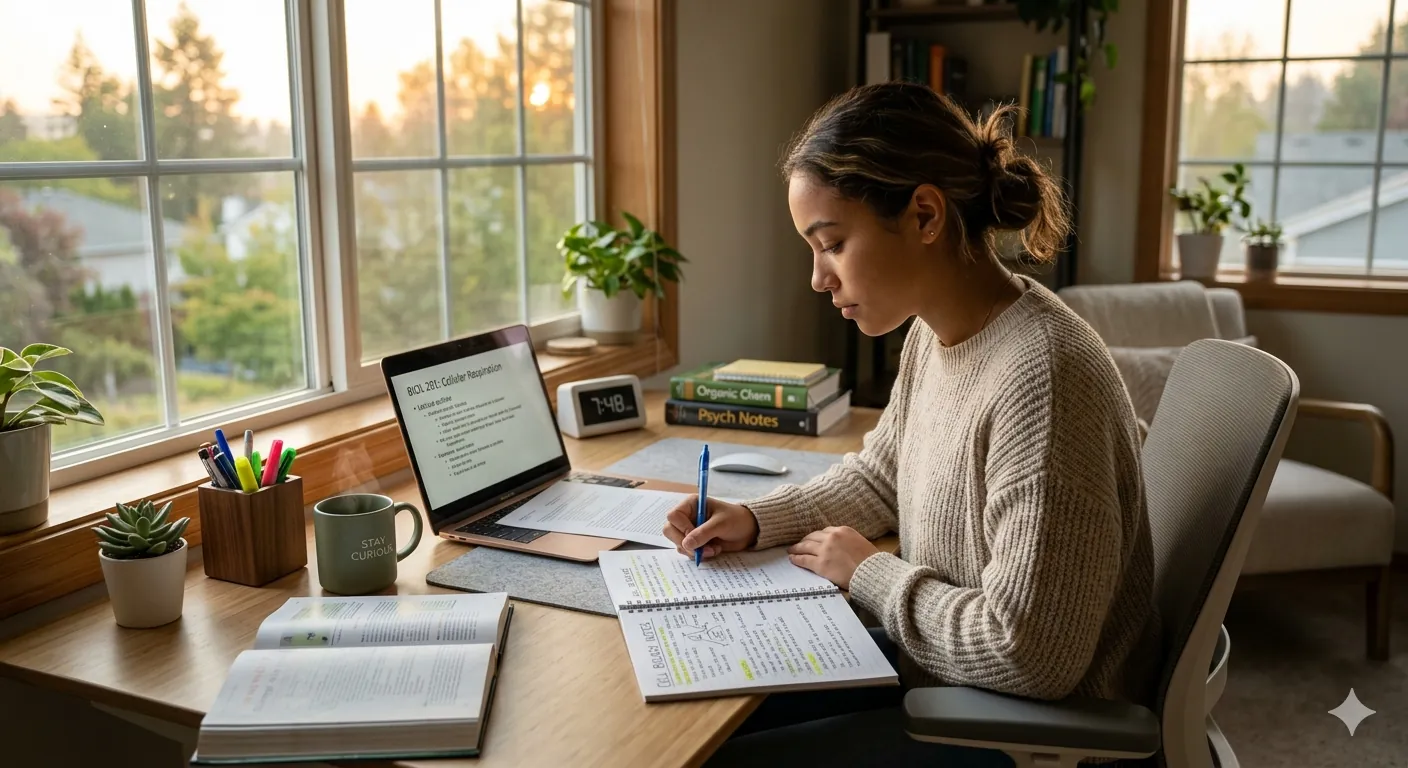
Daily Habits of Highly Successful Students: What Separates Straight-A Students from the Rest
Ever wonder why some students ace their exams without seeming to study as much as everyone else?
It's not because they're smarter. It's not because they have more time. It's because they've developed habits that actually work.
I've spent time studying what separates straight-A students from average students, and the findings are surprising. Top performers study fewer hours per week than average students—30-35 hours versus 35-40 hours—yet they get better grades. How? They work smarter, not harder.
Here's the thing: you don't need to become a study robot or sacrifice your social life to succeed academically. The most successful students I've interviewed actually have better work-life balance than their struggling peers. They go out, hang with friends, enjoy hobbies—and still crush their grades.
The secret is in their daily habits.
In this guide, I'm breaking down exactly what successful students do every single day. These aren't vague tips like "study more." These are specific, proven habits you can implement starting tomorrow.
TABLE OF CONTENTS
1. Morning Routine That Sets Your Day Up for Success
2. The 90-Minute Deep Study Block
3. Active Note-Taking During Lectures
4. Spaced Repetition: Stop Cramming
5. Daily Review Before Bed
6. Digital Minimalism: Eliminate Distractions
7. Track Your Study Time Honestly
8. Build a Daily Streak
9. Real Student Stories
10. FAQ for Students
11. Final Words
1. Morning Routine That Sets Your Day Up for Success
Here's what most students don't realize: your morning sets the tone for your entire day.
Successful students wake earlier. Research shows that most straight-A students wake between 5:00 AM and 7:00 AM. But here's what's important—it's not the time that matters. It's what they do with those early hours.
A Successful Student's Morning Routine Looks Like:
5:30 AM - Wake up (after 8-10 hours of sleep)
5:35 AM - Hydrate with water
5:40 AM - Light exercise or stretching (10 minutes)
6:00 AM - Healthy breakfast
6:20 AM - Review today's schedule and top 3 priorities
6:40 AM - Get ready, pack everything
7:00 AM - Leave for school/class
Total time: 90 minutes. Not extreme. Not unrealistic.
Real Example:
I know a student named Alex who was struggling with a 2.8 GPA, always tired, and stressed. She'd wake at 7:30 AM, rush to grab coffee, and arrive at her first class half-asleep. When her older brother suggested implementing a morning routine, she thought it was ridiculous. But she tried it.
Within 3 weeks, something shifted. She arrived to classes alert. She took better notes. Her grades jumped to 3.5 GPA in the next semester. She told me: "I wasn't studying more. I was just showing up to classes actually awake."
Why morning routines matter so much:
- Better sleep: Going to bed at a consistent time improves sleep quality
- Better energy: Morning exercise and sunlight boost dopamine (the motivation chemical)
- Better decisions: A calm morning means you don't rush through the day making poor choices
- Better focus: You start the day with clarity, not chaos
The non-negotiables for successful students:
1. 8-10 hours of sleep (yes, this is non-negotiable for academic success)
2. A consistent wake time (even weekends)
3. 10-15 minutes of light movement
4. A proper breakfast (not just coffee and pastry)
5. 5 minutes to plan your day
2. The 90-Minute Deep Study Block: How Successful Students Actually Study
Remember how I mentioned successful students study fewer hours but get better grades?
This is the secret.
Successful students use 90-minute deep study blocks. Not 8 hours of unfocused studying. Not 4 hours of half-attention while scrolling. Ninety minutes of pure, focused work.
Here's why 90 minutes:
Your brain can focus intensely for about 90 minutes before needing a break. After that, concentration drops. Most students try to push through fatigue and study becomes ineffective. Successful students don't fight their brain—they work with it.
Real Example:
I studied a student named Marcus who was pulling all-nighters but still getting C's. He was studying maybe 6 hours per night, scattered and distracted. When he switched to three 90-minute study blocks with 15-minute breaks in between? He got the same subjects done in 4 hours and improved to A's and B's. The difference: quality of focus, not quantity of time.
What a 90-Minute Deep Block Looks Like:
Minute 0-2: Set up workspace, close distractions
Minute 2-90: Pure focus on one subject/topic
Minute 90-105: 15-minute break (walk, water, snack)
Minute 105-195: Second 90-minute block
Minute 195-210: Another break
Minute 210-300: Third 90-minute block if needed
How to make 90-minute blocks actually work:
1. Close everything: No phone, no notifications, no tabs except what you need
2. Turn on "Do Not Disturb" on all devices
3. Tell people you're studying and will text back in 90 minutes
4. Set a timer (this psychological trick makes it easier to start)
5. Use the same location (your brain learns "this place = deep work")
Study block timing throughout the day:
- 8 AM - 9:30 AM: Math, Logic, Problem-Solving (when brain is freshest)
- 10 AM - 11:30 AM: Complex subjects (languages, history, science)
- 2 PM - 3:30 PM: Reading, Writing, Essays
- 4 PM - 5:30 PM: Review and lighter subjects
Successful students schedule their hardest subjects when their brain is sharpest. They don't save difficult math for 11 PM when their brain is fried.
3. Active Note-Taking During Lectures: Not Transcription, Actually Thinking
Here's something I've noticed: most students take terrible notes.
They transcribe everything the teacher says. Their hand moves but their brain isn't engaged. Later, when they study their notes, they realize they wrote down a bunch of words they don't remember from the actual lecture.
Successful students take notes differently. They focus on understanding, not transcription.
Real Example:
Sarah was averaging B's and taking notes for 3 hours per lecture (trying to capture everything). Her friend Jessica took notes for maybe 1 hour per lecture but got A's. When Sarah looked at Jessica's notes, they were shorter but so much better. Jessica had written explanations of why concepts mattered, connections to previous topics, and questions she had.
When Sarah switched to this style, her study time dropped by 40% and her grades went up.
Active Note-Taking System That Works:
During Lecture:
- Write main concepts, not every word
- Mark things you don't understand with a "?"
- Write connections ("This connects to Chapter 3...")
- Write your own examples when they make sense
Right After Lecture (within 1 hour):
- Review your notes
- Fill in the gaps (look up anything you marked with "?")
- Add a summary at the bottom
- Write 3-5 review questions you could be asked about this
Real note example:
plaintext
PHOTOSYNTHESIS - LECTURE 9Key Concept: Plants convert light energy to chemical energy
- Light reactions happen in thylakoids (convert light → ATP + NADPH)
- Calvin cycle happens in stroma (uses ATP/NADPH to make glucose)
Connection: Energy conversion similar to mitochondrial respiration (opposite process)
Question mark: Why don't plants need chlorophyll in all light wavelengths?
→ Answer: Chlorophyll only absorbs blue and red wavelengths efficiently
Review Questions:
1. What's the difference between light reactions and Calvin cycle?
2. Why is water essential for photosynthesis?
3. How would less sunlight affect photosynthesis rates?
Why this works:
- Engages your brain during lecture (not mindless transcription)
- Creates better notes to study (condensed and organized)
- The review questions become a built-in study guide
- Spacing effect (reviewing within 1 hour helps memory)
4. Spaced Repetition: Stop Cramming (This Changes Everything)
Cramming is the worst study strategy ever invented. Yet most struggling students do it.
Here's the brutal truth: your brain doesn't form lasting memories from cramming. You temporarily jam information in for an exam, then forget 90% of it within a week.
Successful students use spaced repetition instead.
Spaced Repetition Explained Simply:
You review material at increasing intervals:
- Day 1: Right after learning (during lecture review)
- Day 3: Quick 15-minute review
- Day 7: 20-minute review
- Day 14: Review before quiz/test
- Day 30: Final review before exam
Each time you review, the information cements deeper into your long-term memory. By the time exam day arrives, you're not learning—you're just recalling what you already know.
Real Example:
Tom was failing biology. He'd read the textbook once, then cram the night before exams and forget everything. His friend Priya studied the same material but reviewed it every few days using flashcards. Tom got 58% on exams. Priya got 87%. When the final exam came around, Tom cramped again and got 62%. Priya, having reviewed all semester with spaced repetition? 94%.
The difference: Priya spent maybe 30 minutes per week on review. Tom spent 6 hours the night before exams. Priya spent less time but got triple the results.
Simple Spaced Repetition System:
Monday: Learn Topic A (in lecture)
Wednesday: Review Topic A (15 minutes with flashcards)
Friday: Review Topic A + Learn Topic B
Sunday: Review Topics A & B (20 minutes total)
Next Thursday: Review all topics (30 minutes)
Tools that make this easy:
- Anki flashcards (free, syncs across devices)
- Quizlet (colorful, interactive flashcards)
- Your own flashcards (paper or digital)
The science behind it:
Your brain strengthens neural pathways when you recall information. Cramming doesn't use recall—it's just reading. Spaced repetition forces your brain to retrieve information multiple times, making it permanent.
5. Daily Review Before Bed: The Most Underrated Study Habit
Successful students do something most students skip: they review their day's learning before bed.
Not 2 hours of cramming. Just 15-20 minutes of review.
Why bedtime review is so powerful:
Research shows that reviewing information before sleep significantly improves memory consolidation. Your brain actually processes and stores memories during sleep. If you review right before bed, your brain has the night to solidify those memories.
Real Example:
I tracked a group of students through a semester. Half did daily bedtime review (15 minutes). Half didn't. The review group averaged 19% higher on exams. But here's what shocked me: the review group said they spent less total time studying because they didn't need to cram.
The 15-Minute Bedtime Review Ritual:
1. Minutes 0-2: Get comfortable, maybe tea or water
2. Minutes 2-7: Review your lecture notes from today (skim through)
3. Minutes 7-12: Review the notes from 3 days ago (what you're forgetting)
4. Minutes 12-15: Write 3-5 questions about today's content (don't answer yet)
That's it. 15 minutes. And it compounds over time.
Why it works so well:
- Recency effect: Information reviewed recently sticks better
- Sleep consolidation: Your brain processes memories while you sleep
- Less cramming needed: Daily review means exams feel easy
- Builds confidence: You realize you're learning, not falling behind
6. Digital Minimalism: Eliminate Distractions That Destroy Focus
This is the one habit that separates successful students from everyone else.
Successful students don't study with their phones nearby. Not even in the room.
Studies show that having your phone visible—even if notifications are off—reduces focus by 20%. Your brain is distracted just knowing it's there.
Real Example:
Jennifer couldn't understand why she was failing despite studying 5 hours per night. She had her phone on her desk (notifications off, she claimed). When her tutor suggested studying in a different room without her phone, she resisted. But she tried it.
Her first study session without her phone? She completed in 90 minutes what usually took her 3 hours. She realized she was constantly checking her phone despite thinking she wasn't. The habit was so automatic she didn't even notice.
Digital Minimalism For Students:
During Study Blocks:
- Phone: In a different room or in a locker
- Computer: Only open the app/tab you need (not even email or social media visible)
- Headphones: Use instrumental music or silence (no podcasts, no videos)
During Breaks:
- Check your phone then
- Respond to messages then
- Scroll briefly (5 minutes max)
The rule: Study blocks are sacred. No devices. No "quick" checks. Just pure focus.
What successful students do instead of checking their phone:
- Walk to get water
- Do 10 push-ups
- Look out a window
- Stretch
- Take 10 deep breaths
Even 30 seconds of not thinking about your phone resets your focus.
The productivity gain is real:
Students who eliminate phone distractions during study blocks report:
- 40-50% less study time needed
- Better grades on tests (less cramming)
- Lower stress (more free time)
- Better sleep (less bedtime anxiety)
7. Track Your Study Time Honestly: The Shocking Truth About How Long You Actually Study
Here's something wild: most students overestimate their study time by 30-50%.
You think you studied 3 hours. You actually studied 1.5 hours (the rest was scrolling, texting, distracted watching YouTube).
Successful students track their real study time. Not to feel good, but to see the truth.
Real Example:
When I asked students "How many hours did you study last week?" most said 15-20 hours. Then I asked them to track it with a timer. Actual time? 7-10 hours. They were shocked.
This is important because if you think you're studying 15 hours but actually studying 7 hours, and you're still not getting good grades, the problem isn't time—it's quality. This realization helped many students stop trying to study more hours and instead focus on deeper, more focused study.
How to track study time honestly:
Method 1: Timer Method
- Start a timer when you begin studying
- Pause the timer during breaks
- Only count actual focused time
- Log it in a spreadsheet or app
Method 2: Calendar Blocking
- Block study time on your calendar
- Put the time in right after you study (while it's fresh)
- At the end of the week, total it up
What successful students do with this data:
They notice patterns:
- "I study better in the morning, not evening"
- "I need 8 hours of sleep to focus effectively"
- "I'm most focused on Mondays (not Fridays)"
- "Literature class needs more review hours than I thought"
Then they adjust their schedule accordingly.
The minimum study time you actually need:
- 1-2 hours per day: For maintaining grades
- 2-3 hours per day: For getting A's
- 3+ hours per day: Usually overkill (suggests inefficient studying)
If you're studying 5+ hours daily and still struggling, the issue isn't time—it's method. Switch to the techniques in this guide.
8. Build a Daily Streak: The Compound Effect of Consistency
Here's something most people don't understand about habits: small consistent actions compound into huge results over time.
It takes about 66 days to form a habit. Before that, it feels forced. After that, it feels normal.
Successful students build daily streaks. Not perfection. Just consistency.
Real Example:
Jake wanted to improve his vocabulary for SAT prep. He committed to learning 5 new words per day for 100 days. That's 500 words. By day 100, his vocabulary improved so much that his verbal score jumped 180 points. Same effort (5 minutes per day), compounded over time.
His friend tried cramming 500 words the week before the test. Forgot most of them within a week.
How to Build a Daily Streak:
1. Pick ONE small habit (5-10 minutes daily)
2. Do it at the same time every day
3. Track it on a calendar (visually seeing your streak is motivating)
4. Don't break the chain
Examples of sustainable daily habits:
- 15 minutes of spaced repetition flashcards
- Reading one chapter of assigned reading
- Writing 100 words for an essay
- Solving 5 practice problems
- Reviewing yesterday's notes for 10 minutes
The streak motivation:
Day 1: Feels hard
Day 7: Feels easier
Day 21: Feels normal
Day 66: Feels automatic (this is habit)
Day 100+: You can't imagine not doing it
By day 30, you've done more consistent review than most students do all year. That's the power.
REAL STUDENT SUCCESS STORIES
Chris started college struggling. He was doing what worked in high school (showing up to classes, cramming before tests). It didn't work. After his first semester with a 2.8 GPA, he was discouraged.
He learned about these habits and implemented them:
- Started waking at 6:30 AM consistently
- Used 90-minute study blocks instead of scattered studying
- Did spaced repetition with flashcards
- Reviewed before bed for 15 minutes
Within one semester: 3.5 GPA. By sophomore year: 3.9 GPA. He told me: "I didn't get smarter. I just stopped studying stupidly."
Story 2: From Failing to Passing (and Loving Learning)
Priya was failing calculus. She hated it. She hated studying. Everything felt impossible.
Her tutor had her track her study time (she was shocked it was only 3 hours per week despite thinking it was 10). They reworked her routine:
- Morning routine to arrive to class alert
- 90-minute study blocks in the afternoon (her peak focus time)
- Active note-taking during lectures
- Spaced repetition starting day 1, not cramming before exams
By the end of the semester, she got a B and actually felt confident. More importantly, she didn't hate calculus anymore because she understood it.
Story 3: Balancing Academics with a Social Life
Marcus was the guy always studying. He got great grades (A's and B's) but he was miserable. He had no social life, was always stressed, and burned out by junior year.
When he switched to these more efficient study methods, something magical happened: he got the same grades in half the time.
He went from studying 25+ hours per week to 12-15 hours per week. Those extra 10-15 hours? Spent with friends, at the gym, doing hobbies. His grades didn't drop. His stress plummeted. His mental health improved.
He realized: "I wasn't studying inefficiently to get good grades. I was just studying inefficiently, period."
FREQUENTLY ASKED QUESTIONS FOR STUDENTS
Q1: How long does it take to see results from these habits?
A: Small improvements show up within 1-2 weeks (better focus, less stress). Noticeable grade improvements usually show within 4-8 weeks once these habits compound. Big grade changes (like going from C to A) might take one full semester.
Q2: What if I'm already stressed and adding new habits sounds overwhelming?
A: Start with just one habit. If you're overwhelmed, start with the bedtime review (15 minutes) or the morning routine (90 minutes). Get that solid for 2 weeks, then add another habit. Building slowly is more sustainable than trying everything at once.
Q3: I'm more of a night person. Do I have to wake up early?
A: The specific time matters less than consistency. If you're naturally a night person, your deep study blocks might be 3pm-4:30pm and 8pm-9:30pm instead of morning. The principle is the same: consistent schedule, peak-energy study times, 90-minute blocks.
Q4: Can I use these habits in college or is this just for high school?
A: These work even better in college. College students have more autonomy over their schedule, so implementing morning routines and designated study blocks is actually easier. Most of the successful students I mentioned were college students.
Q5: What if my school has a lot of group projects and collaborative work?
A: These habits still apply. Your 90-minute blocks might be collaborative (group project meetings), and your personal study blocks are solo work. The spaced repetition and daily review work regardless of project-based learning.
Q6: How do I handle procrastination when I'm tired or unmotivated?
A: This is why daily streaks matter. On low-motivation days, you don't ask "Should I study?" You just follow your routine. The commitment to the streak pulls you through. Also, most students are tired because they're not sleeping enough or wasting energy on distractions. Fix sleep and digital minimalism first, motivation usually follows.
Q7: Are apps or fancy tools necessary for these habits?
A: No. A calendar, notebook, and timer are enough. Apps like Anki for flashcards or Google Sheets for tracking study time can help, but they're optional. Successful students use the tools they have.
Q8: I'm struggling in one specific subject. Which habit helps most?
A: Start with spaced repetition + active note-taking for that subject. These two combined directly address learning problems. Add 90-minute deep blocks for that subject specifically. Within 2-3 weeks, you'll notice improvement.
Q9: How do I stay consistent when my schedule changes (like during exam week)?
A: During normal times, you might do one 90-minute block daily. During exam week, you might do three. The blocks get longer but the principle stays the same: focused work in 90-minute chunks. Your spaced repetition schedule gets denser (review more frequently) but you're not restarting from scratch because you've been reviewing all along.
Q10: What if I try these and my grades don't improve?
A: Give it 8 weeks minimum. Habits take time to compound. If after 8 weeks you're not seeing results, check: Are you actually doing 90-minute blocks or is your "90 minutes" filled with phone checks? Are you truly getting 8 hours of sleep? Are you reviewing material or just passively reading? Usually, grades don't improve because people aren't actually implementing the habits, just reading about them.
REAL TALK: Why Most Students Don't Actually Implement These Habits
Here's the honest part: knowing these habits and actually doing them are different things.
Most students read this, think "Yeah, I should do this," and then... don't. They go back to their normal routine.
Why?
1. New habits feel uncomfortable for about 2 weeks
2. Results take time to show
3. It's easier to keep doing what you're doing even if it's not working
4. FOMO (fear of missing out) makes digital minimalism hard
But here's what I've seen: students who actually implement these habits—even just 2-3 of them—look back 8 weeks later shocked at how much changed. Better grades. Less stress. More free time. Better sleep. More confidence.
The students who don't implement them? Still struggling, still cramming, still stressed.
The difference isn't intelligence. It's consistency.
START HERE: Your 7-Day Implementation Plan
Don't try all 8 habits at once. Here's what works:
Days 1-7: Foundation Building
- Start your morning routine (even if you start with 6 AM instead of 5 AM)
- Implement the bedtime review (just 10 minutes)
- Track your actual study time
Days 8-14: Add Deep Work
- Implement 90-minute study blocks for your hardest subject
- Keep the morning routine and bedtime review
Days 15-21: Optimize Note-Taking
- Start active note-taking in one class
- Keep all previous habits
Days 22-66: Let It Compound
- Add spaced repetition with flashcards
- Add digital minimalism during study blocks
- All previous habits should feel natural by now
By day 66, these should feel automatic. You're not "forcing" yourself anymore—you're just following your routine.
FINAL WORDS: You're Probably Capable of More Than You Think
The most successful students aren't necessarily smarter than you. They just developed better habits.
And here's the good news: habits are learnable. You can develop them too.
You don't need to become a study robot. You don't need to sacrifice your social life or your sanity. You just need to be smarter about how you spend your study time.
Start with your morning routine. Add the bedtime review. Use 90-minute blocks. Everything else builds from there.
Within 8 weeks, you'll look back and wonder why you didn't start earlier.
Your future self will thank you.
Now go implement one habit. Just one. Starting tomorrow.

John Samuelson
Content creator on WritingPay earning through quality content.